

We all remember watching the commercial before the season started. The friendly banter of a home run count between Aaron Judge and Giancarlo Stanton, Alex Bregman and Carlos Correa acting playfully cocky, and Francisco Lindor impersonating a bat flip with his microphone. All of these acted as a precursor to the famous words said by Mike Trout. Let the kids play. A simple and clever marketing campaign basically telling the players to have fun, play with flash, and be themselves. But, in my opinion, the whole story behind the campaign is talked about uncommonly. In this article, I’ll dissect how the campaign’s meaning has been taken and what the “whole story” is as well as its role in the league.
How Has the Slogan’s Meaning Been Defined?
Simply put, the slogan has been an emphasis for players to be themselves. The league is caught in the middle of a transition between the old and new style of the game. This transition has seen players become more flashy and play with a whole new level of hype. But, remnants of the old style still remain. This can be used as an explanation to why David Bote apologized after a bat flip following a very improbable walk-off grand slam. The slogan was taken as the league taking a stance away from this “old style” of baseball.
Now, is this definition incorrect? Absolutely not, but it doesn’t talk about the whole story. For this, I’d like to point to a quote said by Madison Bumgarner, following an argument between him and Max Muncy. Muncy absolutely launched a 92.4-mph fastball from the former into the ocean and performed a casual yet glorious bat flip while staring down the bomb. This created an argument between him and Bumgarner. Concerning the campaign, Bumgarner said,”They want to let everybody be themselves. Let me by myself, that’s me, you know? I’d just as soon fight than walk or whatever. You just do your thing, I’ll do mine. Everybody is different. I can’t speak for everybody else, but that’s just how I want to play. And that’s how I’m going to.”
What is the “Whole Story” and What is its Role?
Bumgarner’s quote perfectly sums up what the whole story is. The fans have been so focused on the flip that they haven’t focused on the reaction of the pitcher or team. Mike Oz put it perfectly when he quoted Isaac Newton’s third law of physics,”For every action, there is an equal and opposite reaction.” This is why Bumgarner brings up a very good point. He is simply expressing the viewpoint of the “opposite reaction”. It’s easy to admire the hype a player creates when they hit a home run or strike out a batter in a huge moment, but the same isn’t for the player receiving the action. Players will get upset in the heat of that moment and the hype they show can be the catalyst of arguments or fights. Certain fights and hit by pitches are just severe and unnecessary examples of the “opposite reaction”.
As an example, I’d like to rewind to October 14, 2015, at Rogers Centre. The pitcher, Sam Dyson. The batter, José Bautista. There’s a one-one count, two outs, and runners at the corners. Preparing his seventh pitch, Dyson throws an inside 97-mph fastball to Bautista. Then, with a quick crack of the bat, the ball soars into deep left field, giving the Blue Jays a 6-3 lead. Bautista stares down the ball, before fiercely tossing the bat aside and rounding the bases. Now, fast forward to May 15, 2016. The Rangers and Blue Jays meet up in Texas. In the 8th inning, Justin Smoak hits a groundball to Adrián Beltré, who quickly throws it to Rougned Odor for the force out. Sliding into second was Bautista, who clashed with Odor before the latter delivered a blow to the former. This caused a commotion in the baseball community, especially with the drama between the two teams and the mini-rivalry it created.
These “equal and opposite reactions” are, in my opinion, where the league went wrong in marketing the campaign. Now, there was nothing glaringly wrong with it, however, they opened a massive door for criticism by not putting a spotlight on the “opposite reaction”. When someone watches the commercial, it’s easy to interpret it as the MLB purely promoting the “equal reaction”, as in the players creating the hype. Now, yes, this is what the MLB wants, but they also want the opposite reaction to flare up. Now, of course, they don’t want players getting hurt, I’m not suggesting that, but they want that to create drama. They want more of the banter between Muncy and Bumgarner, as Muncy said,”He said, ‘Don’t watch the ball, you run.’ I just responded back, ‘If you don’t want me to watch the ball, you can go get it out of the ocean.’” This banter is good for the league, as it creates popularity while no one gets injured.
This is where drama’s role in, not only baseball, but every sport comes into play. Look at a sport like the NBA, and the buzz that was created around a situation like the Kevin Durant-Russell Westbrook relationship after the former went to the Warriors. Situations like those create buzz and make the sport more popular in general. Rob Manfred, the commissioner of baseball, has said, on the record,”…we’re also interested in capturing new fans, particularly young fans.” A sport like the NBA has the young fans that Manfred is trying to attract, and this campaign is creating the buzz that could indirectly accomplish that goal.
Another thing to recognize is Manfred’s desire to market the MLB’s players better. Last July, Manfred spoke about this desire regarding younger players. He said,”We are very interested in having our players more engaged and having higher-profile players and helping our players develop their individual brand.” We’ve seen how branding has taken such an immense role in other sports, with companies like Nike sponsoring popular athletes in the NBA in the form of shoe deals. In Manfred’s mind, branding players in the MLB like in the NBA would help level off that popularity. The thing is, he’s right. Branding would have an immense impact on the popularity of players, therefore helping the sport. The problem with that is when the players don’t want to be marketed. Trout has spoken disagreeing with Manfred, as he said,”Yeah… no. I keep telling you guys, I do as much as I can. But it’s a long baseball season. I got to pick and choose when I want to do things and go from there.”
With this in mind, drama is the next best way to create buzz. That’s why popularity with guys like Bryce Harper has been larger than with Trout. When Harper stares down a massive home run, throws up his bat triumphantly to end a Home Run Derby, and fights in retaliation of being hit by a pitch, this will inevitably create more buzz because Harper is a flashier player. This increases the popularity of the player and the sport without marketing being involved.
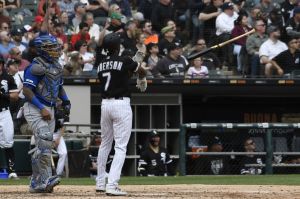
Now, of course, with drama there will always be debacles. This has clearly been seen in the Tim Anderson-Brad Keller situation as well as with Bautista and Odor. The thing is, drama is likely the easiest way to create popularity in the league. The “equal and opposite reactions” create buzz between sports fans in general, no matter how severe. This helps the MLB and essentially helps to advance what Manfred wants. A younger and more competitive game between players or teams, one that creates rivalries. Rivalries that allow the fans to tune in when a competitive drive between players commences, without a violent aspect. In turn, this creates more popularity for the players, the teams, and the sport itself.
 The MLB Enthusiast