

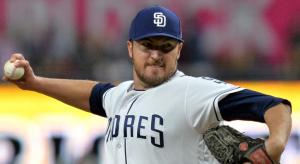
The date is September 25, 2013. Nearing the end of a winning yet disappointing season, the Yankees get ready to battle the playoff-bound Rays. On the mound, spectacular southpaw David Price faces the mediocre Phil Hughes. After a satisfactory 2012 season, Hughes seemed to be in a haze. He had shown signs of quality yet he wasn’t able to keep it on a year-to-year basis. That day would add to the turmoil of a horrendous year, as Hughes gave up seven hits, three runs, a walk, and struck out two through two innings. This culminated in an 8-3 loss for the Yankees, getting Hughes his 14th loss.
That line ended what was already a disappointing season for Hughes, as he finished 4-14 with a 5.19 ERA, 1.46 WHIP, 121 K, 42 BB, and a .293 BAA in 145.2 IP. His career thus far could be summed up as a cold fire. The oxymoron shows that he had sparks of something yet he wasn’t able to keep it going. The Yankees moved on from Hughes that offseason, what they thought was for the better. Seeing his sparks, the Twins gambled on Hughes for a hefty price tag. Little did they know that this would start one of the most miraculous seasons of a pitcher in this era, possibly in the history of baseball.
The Offseason
At the start of the 2014 offseason, the Twins needed a direction. The plague of three consecutive 95+ loss seasons was taking a large toll on the team. The attendance of fans per game had dropped 9,210 in just three years. If anything has become clear to baseball fans, decreased attendance is decreased revenue. So going into the offseason, it’s understandable why the Twins were willing to make risky signings to get some extra wins. While being glorious, their 2010 season mirrored a passing cloud, leaving as quickly as it had come. The front office coveted replicating that success, which is why they wanted to make some splashes in free agency.
The first to sign was Ricky Nolasco. Nolasco was an interesting pitcher, similar to Hughes regarding the cold fire metaphor. He had shown signs of something, yet he wasn’t able to piece it together. In 2013, he was able to post some above average numbers. Such numbers included a 13-11 record, 3.70 ERA, 1.21 WHIP, 165 K, 46 BB, and a .255 BAA in 199.1 IP. Despite high numbers in his BAA and ERA, the Twins gambled on Nolasco in the form of a four-year, $49M contract with a fifth-year club option.
The next to come was Hughes. Nowadays, the “cold fire” of Hughes’s career likely would seem mediocre to many teams. In an era when free agency was at its peak, however, his upside attracted interest in a surplus of money with some teams. The Twins were one, and they attracted his interest with a three-year, $24M contract. With that, the Twins were set with a rotation of Nolasco, Hughes, and veteran Kevin Correia with Kyle Gibson and Yohan Pino joining later.
The expectations the Twins walked into the season with were, to be blunt, very optimistic. While being an improvement over the year previous, a 70-92 record isn’t impressive in any form of the word. Outside of rookie Danny Santana and prime-entering Brian Dozier, the hitting was, for the most part, underwhelming. The Nolasco experiment went south swiftly, as he finished with the worst ERA and WHIP in that rotation. Outside of him, Correia, Gibson, and Pino were quite mediocre. There was one outlier, however, who was quite an odd case.
Hughes greatly improved upon his 2013 season. While not one of the flashiest pitchers in baseball, his numbers were very satisfactory. Such numbers included a 3.52 ERA, 1.13 WHIP, 186 K, 16 BB, and a .268 BAA in 209.2 IP. Now, what makes these numbers so special is the strikeout to walk rate. Despite giving up hits at a negatively high clip, his control was other-worldly. As you can see, his walk count for almost 210 IP was extraordinarily low at 16 (1 intentional).
With that walk count, his BB/9 was an unbelievable 0.69. That alone was the 4th best single-season BB/9 in the history of the American League, tied with Cy Young’s 1904 season. Another very interesting stat to look at with this season which, in my opinion, makes it so historic is K/BB. Hughes’s K/BB in 2014 was 11.63 which is, suffice to say, unreal. It’s so unreal that it leads everyone in the American League, in a single season, in that stat. The second person who comes close is Cliff Lee’s 2010 season, which was 1.35 behind Hughes.
At the surface, Hughes’s season isn’t very impressive at all when compared to others that decade or even that season. His ERA ranked 42nd and WHIP 20th amongst league leaders in 2014. Once digging deeper, however, the season becomes much more impressive. As the game of baseball has evolved for pitchers, the control aspect has become much more prevalent. Hughes’s season adds evidence to that, finally giving that cold fire a warm flame. As control becomes more prominent in the league’s future, so will control outliers like Hughes’s 2014 season. Therefore, many more cold fires will gain warm flames.
 The MLB Enthusiast