
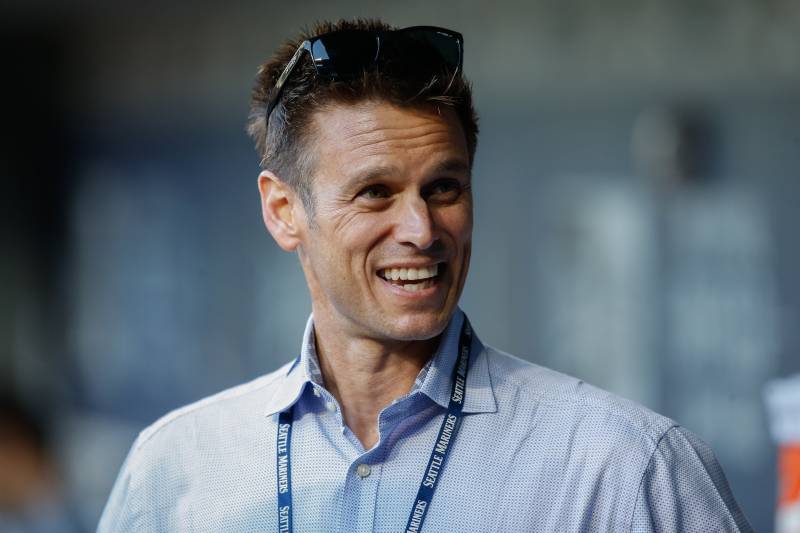
The Mariners have been mired in mediocrity for what seems like forever. Despite some great names in their history, like Martinez and Griffey Jr, they have failed to amass a very successful résumé, greatly waned by the debacle of 2001. They have never been considered very creative themselves, as they often did what any team tried to do in order to win. Collect prospects and hand out albatross contracts. That is, potentially, until last offseason, with their “rebuild”, which may change the infrastructure of the concept forever.
Rebuilding itself has become a preeminent part in almost every sport. The ideal behind the concept itself is simple, when your team’s dominance has severed, you change the roster to amass a more powerful team. While that ideal is the constant in a rebuild, the ways behind running it differ immensely. Thus why there have been front offices who have been deemed as game changing behind the concept of rebuilding. Such front offices include the Brewers under Stearns and Melvin, Cubs under Epstein and Hoyer, Astros under Luhnow and Wade, and Braves under Coppolella and Anthopoulos. All of these front offices have run successful rebuilds with varying degrees of success. While a chicken-and-egg metaphor is expressed in the spread of rebuild ideas, these teams took constants and added their baseball minds to it. As aforementioned, most have built under constants, while some of the ideals of Dipoto’s rebuild are under a different umbrella.
The Rebuild
To start, a timeline must be established to develop context. Consider this a prologue if you will. After a disappointing end to the season, with the Mariners missing the playoffs despite an impressive 89-73 record. This caused Dipoto to face a directional dilemma. The roster itself had a vast amount of depth, but it wasn’t able to make the final leap. This was the main catalyst in Dipoto’s decision to rebuild. Despite pouring money into talented assets, the result wasn’t as promising as it could’ve been. With that, a rebuild implied itself to be an ace in his back pocket. While not promising success, it presented more opportunity then garnering a surplus of depth.
With that, Dipoto had many intriguing pieces to be part of the rebuild. The most notable was elite closer Edwin Díaz, who was coming off a season where he just won AL reliever of the year. For tier 2, injury prone ace Paxton, all-star Segura, spectacular reliever Colomé, and Canó coming back from a PED suspension. In tier 3, defensive-minded catcher Zunino and toolsy outfielder Heredia take prominent roles. For a team eager to dive right into a rebuild, these are genuine pieces to gain a head start.
Most of Dipoto’s trades themselves followed the role of a traditional rebuild. Trading major league pieces for stalwart prospects or young major leaguers. For Paxton, he received southpaw Justus Sheffield. For Canó and Díaz, he received a durable starter in Dunn and a lefty contact-power bat in Kelenic. For Zunino and Heredia, he received a swift player and bat in Smith. For Segura, he received a very toolsy shortstop in Crawford. For Colomé, he received a prospectively good catcher in Narváez. The goal with most of his trades was straightforward, make the team younger to try and build a larger window in a few years, like a regular rebuild.
While controversy can easily be drawn from the Segura and Canó-Díaz trades, there was justifiable reason behind both. Segura, while being a versatile contact bat, has a massive contract paying him an annual average value of $14.25M per year until at least 2023. It’s for this reason why a top prospect couldn’t be acquired his talents. In the Canó-Díaz trade, a seemingly underwhelming bounty of prospects was received, along with bad contracts in Bruce and Swarzak. There was also mystery in trading Díaz, who is under control until the 2023 season, when Dipoto said to aim for a window starting in 3 years. The problem was Canó’s contract, which makes Segura’s deal look tame in comparison. Canó is receiving an annual average value of $24M until the 2024 season, when he will be 41. To be able to recieve prospects close to the caliber of Kelenic, a great piece was needed in the deal, so Haniger or Díaz were presented as the main candidates. Haniger is more valuable as a hitter with a bounty of power with contact. Being able to gain 2 notable prospects while losing Canó’s entire deal for the cost of a great reliever and two mediocre contracts is a no-brainer, especially when the decline of costs of relievers is factored in.
How Could He Be Such a Great General Manager?
The reason why I imply Dipoto to be such a special general manager isn’t because of the trades he made, it’s the transition he may make for rebuilding. While committing to ideals of a traditional rebuild, he has also devoted his rebuild to retooling. Retooling is a concept that isn’t practiced often in baseball. If a team is on a decline from contending, but are still able to make the playoffs, they try to greatly supplement their roster, and if a team is trying to rebuild, they try to trade most or every player of value. Retooling can be considered a moderate part of this spectrum, despite how ambiguous the concept itself is. It allows a team to assess the value of pieces and whether or not to build around or move on from them. A retool within a traditional rebuild is very rare to be seen, yet Dipoto has presented himself as an entrepreneur in this concept.
Granted, the payroll of the 2018 Mariners partially swayed the direction of the retool Dipoto has run. They were forced to take major league veterans in Encarnación, Bruce, and Swarzak in return for the bloated salaries of Canó and Segura. However, Dipoto took the opportunity to expand upon the talent on the roster by signing other talent. Most notably was Japanese southpaw Kikuchi, who received a bountiful four-year, $56M contract, which was mainly supplemented by the immense hype he received in Japan. For the hitting core, other, more under-the-radar acquirements, include Beckham, a decent shortstop who had a satisfactory 2017 season despite regressing in 2018, as well as Santana, a power bat from the Brewers looking to make a name for himself as the main part of a lineup. For the bullpen, he signed closer Strickland, who, despite his best days being behind him, is still an adequate closer. Sadly, his injury history has remained to hinder him, and he was shut down for a very long stretch a few games after the start of the season. He also signed Gearrin, an ample yet inconsistent reliever, who provides depth leading up to the 9th.
As I have implied many times, Dipoto may be a front runner in this possible transition. The largest constant in a rebuild has been to lose as much value to the current roster until a new contending window opens. Dipoto has molded this constant into something more interesting. While losing multitudes of value, he has tried to build a winner while being very discreet. Hence the signings of Beckham, Kikuchi, Gearrin, and Strickland. While trying to build a sustained winner in a few years, he also wants to build an under-the-radar winner now. The combination of both is very rare, and Dipoto’s rebuild may be the prime example of this concept a decade or so down the line.
I know I have presented Dipoto as an entrepreneurial general manager. I know there’s a chance his entire experiment fails, and the Mariners return to square one. However, I am a firm believer in the saying “fortune favors the bold”. The best general managers are ones who aren’t afraid to make risky and maybe even controversial moves. Take the Yelich trade as a prime example. At the beginning, it looked risky for the Brewers to trade their top prospect for a guy who hadn’t yet made a name for himself. It was a risky decision. Then fast forward a year, and he has an MVP under his belt and led the team to a division title and being one game away from the pennant. Fortune favors the bold. Although the rebuild Dipoto has done won’t unfold for years, the moves he has made so far at least makes it plausible to assume that it could be the start of a new movement in baseball rebuilds.
 The MLB Enthusiast