


Since the Cubs have acquired Quintana, it has been disappointing to be blunt. It seems the White Sox have won the deal in almost every way. They got two prospects with tremendous upside while the Cubs seem to have gotten the remnants of a once spectacular pitcher. Now, while it seems this way, the answer to an improbable return may be one that requires a strategic yet simpler move to the roster. In this article, I’ll analyze Quintana’s stats, present that strategic move, and analyze how it could affect him, and potentially Contreras, in the years to come.
To the chagrin of many Cubs fans, a quite consistent Quintana struggled to find consistency last year. While the irony is humorous, the stats are mediocre when comparing them with his career. Last season he posted a 4.03 ERA, 1.32 WHIP, 158 K, 68 BB, and a .246 BAA in 174.1 IP. This left many fans scratching their heads, wondering what happened to a pitcher who looked monstrous as a member of the White Sox. Well, when you dive into the numbers, they really aren’t much different than they were then, perhaps becoming a beacon that those old numbers can return.
Quintana has mostly been quite consistent in his advanced stats, and there usually hasn’t been an outlier in them. That is until this season, in which something peculiar was found.
- 2013: 7.38 K/9, 2.52 BB/9, 1.04 HR/9, 8.46 H/9, 2.93 K/BB
- 2014: 8 K/9, 2.34 BB/9, 0.45 HR/9, 8.85 H/9, 3.42 K/BB
- 2015: 7.72 K/9, 1.92 BB/9, 0.7 HR/9, 9.51 H/9, 4.02 K/BB
- 2016: 7.83 K/9, 2.16 BB/9, 0.95 HR/9, 8.31 H/9, 3.62 K/BB
- 2017: 9.87 K/9, 2.91 BB/9, 1.1 HR/9, 8.11 H/9, 3.39 K/BB
- 2018: 8.16 K/9, 3.51 BB/9, 1.29 HR/9, 8.36 H/9, 2.32 K/BB
The reason I have bolded the outlier stats in his 2018 season is that I believe they are the preeminent cause of his struggles. His K/9 saw an increase in what his average was before 2017, but his BB/9, and subsequently K/BB, also saw a negative increase. The fact that his walks went up so much definitely seems odd, after all, Quintana has never been the type of pitcher to do that. That’s where an interesting theory surrounding types and frequencies of pitches comes into play.
Quintana’s arsenal of pitches and their frequencies aren’t much different than some successful pitchers in the league, such as J.A. Happ and Jon Lester. According to Statcast, Quintana threw his four-seamer 49.7% of the time, curveball 24.9% of the time, sinker 18.6% of the time, and changeup 6.8% of the time in 2018. This alone doesn’t tell you much, but when provided with more examples, a pattern can start to develop.
Quintana was caught by three catchers last year. Those three were Cubs main backstop Willson Contreras, young backup Victor Caratini, and veteran Chris Gimenez. Below, I have broken down his stats being caught by all three catchers.
- Contreras: 3.44 ERA, 1.26 WHIP, 108 K, 53 BB, .230/.313/.368 opposing stat line, 125.2 IP
- Caratini: 5.36 ERA, 1.40 WHIP, 47 K, 13 BB, .271/.321/.525 opposing stat line, 43.2 IP
- Gimenez: 7.20 ERA, 2.20 WHIP, 3 K, 2 BB, .375/.423/.583 opposing stat line, 5 IP
As you can see, Quintana, when being caught by Contreras, saw stats similar to his previous years on the White Sox. With Caratini and Gimenez however, it was nearly the polar opposite. To reinforce this idea, Mike Montgomery, Cubs swingman, has a similar pitch arsenal to Quintana. According to Statcast, he threw his four-seamer 50.1% of the time, curveball 21.9% of the time, changeup 20% of the time, and cutter 8.1% of the time. While the cutter is unique compared to Quintana’s sinker, they’re both fastball reliant and throw their curveball about a quarter of the time. The only outlier in the same stat is Montgomery’s larger use of his changeup, by 13.2%.
Montgomery, like Quintana, was caught by Contreras, Caratini, and Gimenez last season. Below, I have also broken down Montgomery’s stats when caught by each catcher.
- Contreras: 4.05 ERA, 1.40 WHIP, 62 K, 29 BB, .275/.340/.388 opposing stat line, 86.2 IP
- Caratini: 5.23 ERA, 1.65 WHIP, 10 K, 6 BB, .326/.376/.465 opposing stat line, 20.2 IP
- Gimenez: 2.16 ERA, 0.90 WHIP, 14 K, 4 BB, .183/.234/.300 opposing stat line, 16.2 IP
As you can see, both Quintana and Montgomery did see low performances when being caught by Caratini. With a similar fastball and curveball heavy arsenal, this does create somewhat of a pattern. Quintana did post similar numbers to his previous seasons when being caught by Contreras. The simple solution could be to have Contreras be Quintana’s full-time catcher however, the Cubs are very focused on preserving Contreras’ power, and the first step in that may be less rest. Then comes the potential solution to this issue.
The Solution
Concluding the data from Quintana being caught by the different Cubs catchers, I believe the Cubs should acquire a backup catcher who has successfully caught pitchers with similar archetypes as Quintana. The key is finding a catcher with successful stats catching pitchers with similar pitch frequencies or types. The perfect catcher to help Quintana out in this scenario, Martín Maldonado.
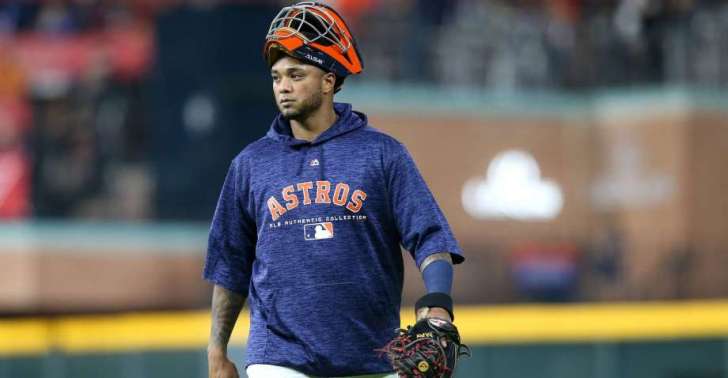
Maldonado is considered a defensive ace among most MLB catchers. The jaw-dropping 49% CS% among 35 attempts is enough to covet the veteran, yet that’s not all he has to offer. His framing is also noteworthy, posting a .005 CSAA and 5.9 framing runs. The blocking department is so-so, as he posted a .001 EPAA and -1.1 blocking runs last season.
Here, I will be focusing on Maldonado’s stats with two pitchers on the Angels who have similar and different pitch archetypes as Quintana, and I will be presenting ways of which Quintana could improve pitch frequencies in his arsenal to better himself should this scenario occur. Below, I have broken down Angels’ starters Tyler Skaggs and Andrew Heaney’s stats while being caught by Maldonado.
- Skaggs: 3.19 ERA, 1.28 WHIP, 69 K, 23 BB, .254/.316/.369 opposing stat line, 73.1 IP
- Heaney: 3.51 ERA, 1.13 WHIP, 99 K, 29 BB, .223/.283/.382 opposing stat line, 97.1 IP
The most similar of those pitchers to Quintana in terms of pitch arsenal is definitely Skaggs. According to Statcast, Skaggs threw his four-seamer 44% of the time, curveball 28.2% of the time, changeup 14% of the time, and sinker 13.9% of the time in 2018. While being fastball heavy, he uses his breaking stuff more often than Quintana, and Maldonado could help transfer some of those stats while catching Skaggs, as well as improve the versatility of his breaking stuff.
Heaney isn’t quite similar to Quintana. According to Statcast, he threw his sinker 58.2% of the time, curveball 25.2% of the time, and changeup 16.6% of the time. While the only striking similarity to Quintana is the use of the curveball, Maldonado could help improve the changeup as a larger pitch to Quintana’s arsenal. The changeup has shown Quintana success in the past he when posted a 31.1 K%, 6.7 BB%, and 31.6 Whiff% in 2018.
While these pitchers aren’t exact clones of Quintana in terms of pitch types and frequencies, they certainly represent some commonalities to it. They also show how Quintana’s arsenal can be improved upon and become more diverse, thus leading to potentially better stats, as seen when Heaney and Skaggs have been caught by Maldonado.
In conclusion, the Quintana issue is a tough one to pinpoint with total accuracy. There will always be different impersonations on how to improve him, such as him using one pitch more, him being caught by a better backup, etc. In the end there are multitudes of interpretations that are logical and could work, but even they have flaws. That’s what I see in this solution. While these pitchers with somewhat similar pitches and frequencies as Quintana have posted good numbers with Maldonado catching them, it’s not a guarantee Quintana can do the same. It’s just a logical guess. One thing that’s for sure is that Quintana’s old self is still there, can still be saved, and the Cubs should be taking every opportunity they can to recover it.
 The MLB Enthusiast
I agree with everything you’ve said.
LikeLike