

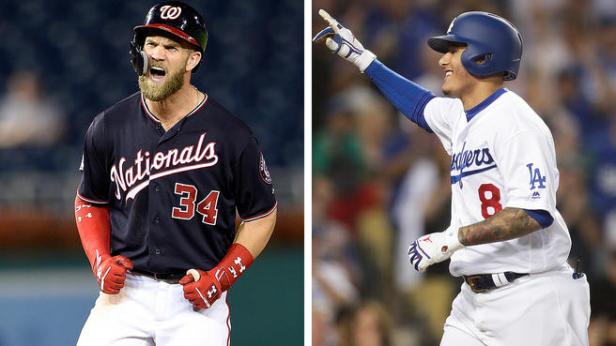
Bryce Harper and Manny Machado are two of the biggest hitting free agents in the history of the game. Both being 26 and the fact that they’ve already have posted MVP/all-star level stats is very impressive. Both of them have been shown to have smaller markets, as Harper has been mostly the Nats and Phillies, while Machado is the White Sox and Phillies. The question is, why are markets of these players so low, and how will it affect the MLB in the coming years?
This isn’t the first year we’ve seen all-star caliber players have small markets. Last season there was a free agent freeze with guys like Jake Arrieta, Yu Darvish, Eric Hosmer, and Alex Cobb. It came with much surprise to fans and backlash against the players, as their reasoning for holdouts and solutions to it were flawed. It was fully expected coming into this offseason and the offseason hasn’t disappointed. So, why is this?
The main thing we can point to is owners becoming more enlightened in terms of what to spend their money on. From offseasons previous, money was thrown at players with an ignorant use of statistics. The best example of this would be Jason Heyward, who was a promising bat before an injury in Atlanta. Coming off of a career season in St. Louis, where he posted a .293/.359/.439 with a 5.6 fWAR, 121 wRC+, and tremendous fielding. While these are good numbers, looking at his previous years strongly imply that it was a career season. The Cubs, led by Jed Hoyer and Theo Epstein, decided to roll the dice and pay him $184M for 8 years. When signed it seemed good, but it came with many repercussions. Heyward has been a Cub for three years, and his best season saw .270/.335/.395 with a 2 fWAR, and a 99 wRC+.
There have been multiple other scenarios where contracts like Heyward have been given to players and have only worked out for a certain amount of years, such as Evan Longoria, Johnny Cueto, Cole Hamels, and Miguel Cabrera. This, in my opinion, is the main reason why we have seen some free agency “freezes”. The owners have been enlightened in their choices of spending money, and have realized that there are other, sometimes better options, promoted by the story of “Moneyball” and the 2002 Oakland Athletics.
In a way, you can’t blame these owners for not giving high-end talent enough money to retire at 26. Dub them however you like, superstars or generational talents, they will one day see a fall in their statistics and the owners would not like that to hinder their ability to sign better talent. Even if it works out for half the contract or slightly longer, they would not like to be paying multimillions of dollars to washed players, or let it hinder in the way of getting players better for their teams. Not to mention, that usually hasn’t been the case for high-end talent getting trust funds.
I would like to point out a quote said by Evan Longoria criticizing these owners.
“As fans, why should “value” for your team even be a consideration? It’s not your money, it’s money that players have worked their whole lives to get to that level and be deserving of. Bottom line, fans should want the best players and product on the field for their team.” -Evan Longoria in an Instagram post
This quote expresses half the argument. Yes, these players are mostly deserving of the contracts, they are high-end talents. However, the owners still don’t want them to hinder their ability to sign free agents with more of a team need in the future. Now yes, the “it’s not your money” argument is used by a lot to fans who argue with fans who side with owners about these free agents. But, the owners essentially are thinking the same as fans who disagree with signing this high-end talent. The owners give the money, and bottom line they decide whether or not they want to give it. You can’t just put a product of every huge free agent on a team because that’s not a wise investment for the future, which is an important deciding factor in this process.
Longoria himself is a large turning reason in this, as he was signed, like many others, to help his team win a title, and like many others it has failed with bad consequences. The whole idea behind signing high-end talent is to win a title, but if you look at most of the top free agent signings it hasn’t worked.
Another reason to show this is success rate with titles. Out of the largest 30 contracts signed in MLB history based on total money given, only 8 of the players have won a World Series with the teams they signed with, 9 counting Verlander who won with Houston long after after signing with Detroit. Those 8 are, in order of contract size, Alex Rodriguez, Price, Derek Jeter, Heyward, Mark Teixeira, Buster Posey, CC Sabathia, and Manny Ramirez. The fact that only 26% of the largest 30 contracts ever signed have resulted in a World Series with that player is alarming.
In my opinion, free agency will have a dramatic shift in the coming years of the MLB. Unless these players become more lenient with the owners, this freeze will continue to happen for the forseeable future, likely resulting in a strike in the coming years. Based on the past, most large free agents will probably ask for very large contracts, which very few teams will supply until late in free agency, again based on the last few years.
There has been talk of a strike coming already in 2021 due to this, and I think that is likely to happen. Unless we see a difference in the thought process of either the owners or players, I think we can change the status of the potential 2021 strike to inevitable. Of course it’s likely the relationship between these players and owners will gain more bad blood, so it’s impossible to predict who will change first. All we know is that this freeze will likely keep occuring as the MLB heads into its rapidly changing future.
 The MLB Enthusiast
Great stuff Steven this is so cool keep up the good work!
LikeLike