

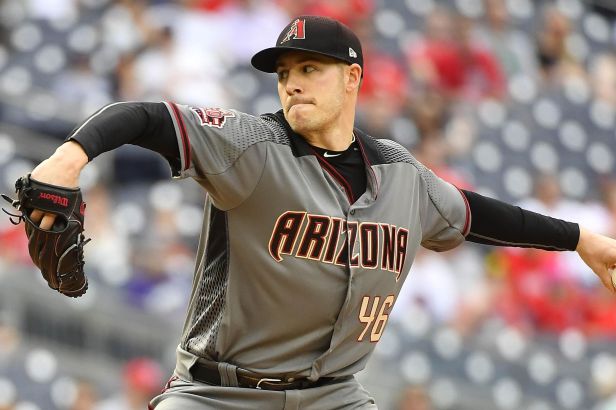
On Tuesday, the Nationals and former Diamondbacks left-handed pitcher Patrick Corbin agreed to a 6-year, $140M contract, averaging 23.3M per season. Last season, the 29-year-old Corbin had a breakout season, highlighted by a 3.15 ERA, 1.05 WHIP, 246 SO, 48 BB, and a .218 BAA in 200 IP. In my opinion, he was the starter on the market with the most upside, having away splits and likely giving the team prime stuff for the next 3-4 years made it very impressive. In this article, I’ll breakdown the signings and how this affects the Nationals for this offseason and in the future.
As I stated before, in my opinion Corbin was the highest upside starter on the market. Having a breakout season likely means he is now entering his prime, so signing a just-entering prime starter to a 6-year deal will likely maximize his effeciency over the next 3-4 years or so, possibly being able to anchor that rotation if Max Scherzer’s age takes a toll on his production, which I think is unlikely. He also has been known to be better away than at home, hopefully making him better after he arrives in Washington.
Now, how does this trade affect Washington? Up until last season, the Nationals had a top rotation in the MLB. In 2017, it was anchored by a 2.51 ERA Scherzer, 2.52 ERA Stephen Strasburg, and 2.96 ERA Gio Gonzalez. In 2018 however, the only pitcher who kept up form was Scherzer, who’s ERA barely decreased, but Strasburg’s ERA decreased to 3.74 in a partially injured season while Gonzalez downgraded to a 4.57 ERA with the team. Getting a dominant lefty who’s entering his prime could help set that ship to more calm waters, comboing him with Scherzer as the two anchors is something most competitive teams would give up elite prospects for.
After this trade, this is what the Nationals’ full rotation is looking like currently going into next season with their 2018 stats:
- Max Scherzer: 2.53 ERA, 0.91 WHIP, 300 SO, 51 BB, .188 BAA, 220.2 IP
- Patrick Corbin: 3.15 ERA, 1.05 WHIP, 246 SO, 48 BB, .218 BAA, 200 IP
- Stephen Strasburg: 3.74 ERA, 1.20 WHIP, 156 SO, 38 BB, .240 BAA, 130 IP
- Tanner Roark: 4.34 ERA, 1.28 WHIP, 146 SO, 50 BB, .262 BAA, 180.1 IP
- Joe Ross: 5.06 ERA, 1.31 WHIP, 7 SO, 4 BB, .274 BAA, 16 IP
Say what you will, but if Ross recovers to his career 4 ERA and 1.29 WHIP and Roark continues on the upward cline he is in, the Nationals could command a lights out rotation going into next season.
I think the big factor for this with the Nationals is Bryce Harper. The big question is whether or not he will be back in DC in the 2019 season. While this deal puts them at a $152.1M payroll with estimated arbitration deals, this doesn’t mean they’re close to the 2019 luxury tax which will be $206M. This means they have $53.9M in available payroll, they could easily sign Harper and another impact bat or relief pitcher to help ignite a deadly staff.
Now, whether or not they sign Harper is the big question. In my opinion, I really don’t see it happening. While they easily can make a large bid for him, I think they will prefer to rely on the big punch of the outfield with Juan Soto, Victor Robles, and Adam Eaton. This leaves room to sign a solid infield bat or relievers, filling bigger needs than reaquiring a star with Harper. This allows gives them a lot of money for next year’s huge starting pitching class highlighted by Chris Sale, Madison Bumgarner, and Justin Verlander.
In my opinion, this is a great signing for the Nationals. They get a prime starter posting great strikeout numbers to help anchor a rotation which is either really good or really bad, and having that consistency they likely will see with him now that he’s entering his prime will really help them. It also leaves them over $50M in payroll to spend on other needs, rounding out a good team to make a possible return to the playoffs. Whether or not they make the playoffs next season, this signing can definitely help their team in the future, possibly returning to the promise land which they so badly covet.
 The MLB Enthusiast