

The trade deadline ended yesterday, and with it did some fans’ hope of getting a few pitchers or so. The Cubs did extremely well this deadline in my opinion, as trading for Jesse Chavez and Brandon Kintzler solidifies an already top 3-5 bullpen in the majors, and Cole Hamels, while having a very tough year, is still an improvement over Tyler Chatwood. The one main struggle that hasn’t seem to be very fixed this season is the rotation. Sure, Hamels is a minor upgrade, but there were other guys available who were better like J.A. Happ, Nathan Eovaldi, and even Matt Harvey. In this article, I’ll breakdown the Cubs’ struggles with their rotation, and whether it can improve or not.
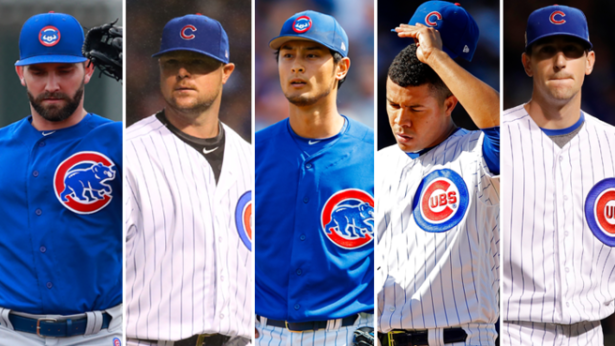
I’ll start by breaking down their general stats. This season, the Cubs’ rotation hasn’t been good, posting a 36-34 record, 4.17 ERA (16th in MLB), 1.39 WHIP (23rd in MLB), 479 strikeouts (19th in MLB), 266 walks (2nd in MLB), and a .247 BAA (14th in MLB). I think it’s safe to say that without the bullpen they have, we’d be a Wild Card team at best with those rotation stats. Most of these stats are a downgrade from what they had last year when their rotation underperformed.
The Cubs’ dominant struggle this season considering their rotation would definitely be their control. Last season, after the entire season, they had 290 walks total from every starting pitcher and a solid 2.82 strikeouts to walks. Now, with 2 months left in the season, they have 266 walks and a much worse 1.8 SO/BB. A good part of the reason this has been happening, in my opinion, is the addition of Tyler Chatwood, who is having one of the worst seasons of his career. He has 85 walks this season, which leads the major leagues by 20, a 0.96 SO/BB, 8.14 walks per 9 innings (a career high), and 7.85 strikeouts per 9 innings (a career high). It’s not just Chatwood that has affected the team’s SO/BB, but it’s also everyone else, as a majority of our starters have seen rises in walks and walks per 9 innings.
José Quintana would probably be the pitcher who has had the most shocking increase in walks and stats dealing with control. Throughout his career, Q has been a solid strikeout pitcher, posting a career 1,083 strikeouts in 1,247.1 innings pitched and a career 7.81 strikeouts per 9 innings. He also had good control stats and relied on it, posting only a 2.58 career BB/9 and a solid 3.03 career SO/BB. This year, however, we’ve seen a completely different Q. His pitches being strikes percentage has been at an all-time low 60.9%, his SO/BB is at an all-time low 1.83, and his BB/9 is at an all-time high 4.35. The one bright spot in Q’s control though is his 7.94 SO/9 this season, which is above average compared to his career.
Jon Lester hasn’t lost very much control, as his control has slightly diminished each year into his Cubs tenure. He’s having a great season though, posting a 3.22 ERA and 1.27 WHIP among other solid stats. The problem would be that his control, while not at all-time lows, has seen rough spots. His pitches per inning are 17, which is the fourth worst in his long 13-year career. His pitches per plate appearance also rank fourth worst in his career at 4.06.
His SO/BB is also at a big rough patch, as it is at 2.02, which ranks third worst in his career. His SO/9 and BB/9 are also below average compared to his career stats, as his SO/9 is 7.09 while his career is at 8.34 and his BB/9 is 3.51 while his career is at 2.93. Now, Lester is 34, so I don’t expect him to put up the stats he did in his prime, and I think he’s doing very good this season, I’m just saying his control has seen decreases.
While only pitching 40 innings this season, Yu Darvish has also seen some big decreases in his control compared to his career. While these seem minuscule compared to the number of innings pitched, it’s still worrying. He has seen career highs in strike percentage, pitches per inning pitched, and pitches per plate appearance. His strike percentage is 61.5% compared to a career 63.4%, his pitches per innings pitched is 18.5 compared to a career 16.4, and his pitches per plate appearance is 4.11 compared to a career 3.95.
He’s also seen career highs with his advanced strikeout and walk stats. I know he’s had some arm problems this season though, so I wouldn’t take these stats extremely seriously. His SO/BB, SO/9, and BB/9 are mostly rocking under Darvish’s usual radar. His strikeouts per 9 innings is still at a very solid 11.03, which ranks barely below his career average of 11.04. His BB/9 are at a career high of 4.73, which ranks much above his very high 3.38. His strikeouts to walks are at a career low 2.33, which ranks almost 1 below his career average of 3.26.
While Mike Montgomery and Kyle Hendricks have also been flying a little under the weather in terms of pitching stats, they aren’t as bad as Quintana, Lester, or Darvish. Control, while being the preeminent issue when it comes to the Cubs’ starters, isn’t the only cause for a rocky rotation. Montgomery, Hendo, and Darvish have seen career highs or large highs in hits per 9 innings and Q, Lester, Darvish, and Hendo have seen some highs in home runs per 9 innings. Somewhat surprisingly, Chatwood’s H/9 and HR/9 have seen career lows or major lows for him, likely due to his crazy pitches and their unpredictability outside the zone.
All of these stats are culminating in worse ERAs for everyone in the rotation except for Lester. Lester saw an improvement in ERA by a lot actually, which is a pleasant surprise for this rough rotation this season. His ERA went from 4.33 in 2017 to 3.22 this year, which is a bit surprising due to the rising walk numbers, but his H/9 has significantly decreased and his HR/9 has also slightly decreased. Hendo’s ERA has gone from 3.03 last year to 3.97 this year, Monty’s went from 3.38 last year to 4.03 this year, Q’s went from 4.15 last year to 4.26 this year, and Darvish’s, although he’s only pitched 40 innings this year, went from 3.86 last year to 4.95 this year.
Now, this issue stands higher than ever with the trade deadline having ended. Sure they got Hamels, but he hasn’t been very good this season, posting a 5-9 record, 4.72 ERA, 1.37 WHIP, 114 strikeouts, 42 walks, and a .258 BAA in 114.1 innings pitched. We also gave up Eddie Butler for Hamels, who last season, had decent stats as a starter for the Cubs, posting a 4-3 record, 3.86 ERA, 1.44 WHIP, 29 strikeouts, 27 walks, and a .245 BAA in 51.1 innings pitched. This is even more impressive considering the average MLB ERA was 4.36 last year compared to 4.15 this year. Also, Butler isn’t even in arbitration yet, so trading him for a rental could’ve hurt the rotation because we could’ve used him instead of Butler.
Now, there weren’t a ton of starting pitchers on the market at this deadline, and I’m not against the Cubs getting Hamels. He has postseason experience and has done well in October in the past, so it seems better to have a guy like him compared to an inexperienced postseason guy like Butler. I think they could’ve instead pursued someone like J.A. Happ, Derek Holland, Nathan Eovaldi, or even Matt Harvey, as the trades for Eovaldi and Happ didn’t cost the Red Sox and Yankees much, so the Cubs definitely could’ve afforded one of them.
We still have some other options for starts if Hamels doesn’t do very well. Duane Underwood Jr. is one of these options for the team, as although he’s only made one start this season, he did well in that start. In it, against the Dodgers at Dodger Stadium, he went 4 innings while giving up 1 run, 3 walks, and striking out 3. We also have Jesse Chavez in our bullpen who, although he hasn’t been very good as a starter, has experience as a starter.
So, although they have struggled this season, there is hope for the Cubs’ rotation this season. For one, Hamels is making his first start tonight, so if he does well on the Cubs he could help to revitalize our rotation. We also have the other options I mentioned if it doesn’t work out, so the rotation definitely has the chance to improve. Our other starters have a cloudy future, as they’ve had unpredictable starts, so that could get better or worse. The one thing that’s for sure is that the Cubs are very much regretting not trading for Justin Verlander.
 The MLB Enthusiast